
Get Paid Faster: 6 Steps to Follow Up on Late Invoices for Trades

When an invoice goes past due, send a short reminder that day. Reattach the invoice, state the amount and due date, and ask for payment within seven days. That single move solves most late payments. For the rest, follow a set cadence: a friendly note before it’s due, a nudge on the due date, then escalating messages at 3, 7, 14, and 30 days, backed by a phone call and, if needed, a demand letter.
TL;DR:
- Sending a reminder on the day an invoice is overdue, including the invoice, amount, and due date, resolves most late payments without further action.
- Following a consistent schedule of email reminders at 3, 7, 14, and 30 days overdue, combined with phone calls if needed, increases collection success.
- Clarifying payment methods, invoice details, and deadlines in every message prevents confusion and delays, especially for new clients or larger jobs.
- Using a documented escalation process with written confirmations and a paper trail is crucial for legal collection efforts or disputes.
- Employing tools that centralize customer data, invoices, and follow-up tasks helps prevent overlooked payments and reduces chasing time.
Table of Contents
- Quick checklist and recommended cadence for late invoice follow up
- Copy-ready email templates for each stage
- Phone calls, documentation, and escalating properly
- Late fees, payment terms, and a short legal checklist
- How to stop late payments before they start
- Using SMS and other channels for payment reminders
- Handling common reasons for late payment and resolving disputes
- Forge: a practical way to keep follow-ups from slipping through the cracks
- Sources
- FAQ
Quick checklist and recommended cadence for late invoice follow up
Most overdue invoices aren’t a fight. They’re an oversight, a cash-flow crunch on the client’s end, or an email that got buried. A consistent reminder cadence catches these before they turn into real collections problems. Here’s the schedule we recommend for trades businesses:
- A few days before the due date — Send a friendly heads-up. No pressure, just a reminder the invoice is coming due.
- On the due date — A short note confirming payment is due today, with the invoice attached again.
- A few days after due — First overdue notice. Still polite, but now it names the amount and asks for a payment date.
- About a week overdue — Second notice, firmer tone. This is also your trigger to pick up the phone.
- Two weeks overdue — Third notice. State clearly what happens if payment doesn’t arrive (late fee, paused work, no new jobs scheduled).
- Around a month overdue — Final demand. Set a hard deadline and outline next steps if it’s ignored.
Before you send anything, double check the basics. Wrong contact email, unclear due date, missing purchase order number, or a missing GST/HST registration number can all delay payment through no fault of the client. A quick pre-check saves you an awkward round of “we never got this.”
Every message in this sequence should include the invoice number, the exact amount owed, the payment methods you accept, and one clear action: “Please pay by Friday” beats “let us know when you can send payment.” Vague asks get vague responses.
Not every client needs the full ladder. A homeowner you’ve worked with for ten years who’s a week late probably just needs one friendly nudge. A brand-new commercial client on a large job, on the other hand, deserves a tighter cadence and less patience. If a new client is already late on the first invoice, that’s a signal to shorten your timeline and move to a call sooner rather than later.
Copy-ready email templates for each stage
Templates save you from staring at a blank screen while you’re frustrated about money you’re owed. Here are five you can copy, adjust, and send today. Swap in your own numbers, names, and dates.
1. Friendly pre-due reminder (3 to 6 days before due date)
Subject: Reminder — Invoice #1042 due Friday
Hi [Name],
Just a quick heads-up that invoice #1042 for $2,400 is due on [date]. I’ve attached it again for convenience. Let me know if you have any questions.
Thanks, [Your name]
2. Due-date reminder
Subject: Invoice #1042 due today
Hi [Name],
This is a friendly note that invoice #1042 ($2,400) is due today. You can pay by e-transfer to [email] or by cheque. Let me know if you need anything from me to process it.
Thanks, [Your name]
3. First overdue notice (1 to 3 days late)
Subject: Invoice #1042 is now overdue
Hi [Name],
Invoice #1042 for $2,400 was due on [date] and hasn’t come through yet. Could you let me know when I can expect payment? Invoice attached again in case it got missed.
Thanks, [Your name]
4. Second, firmer notice (7 to 14 days late)
Subject: Payment needed — invoice #1042, now 10 days overdue
Hi [Name],
Invoice #1042 for $2,400 is now 10 days past due. I haven’t heard back on my last two emails. Please send payment by [specific date] to avoid a late fee under our agreed terms. If there’s an issue with the invoice or the work, let me know right away and we’ll sort it out.
Thanks, [Your name]
5. Final demand (30+ days late)
Subject: Final notice — invoice #1042 due immediately
Hi [Name],
Invoice #1042 for $2,400 is now 30 days overdue. This is a final notice before I refer the account for collection. Payment is required in full by [date]. If I don’t receive payment or hear from you by then, I will proceed with formal collection steps, which may include additional fees and interest as outlined in our agreement.
Please contact me directly if you’d like to resolve this before that date.
[Your name]
- Keep subject lines specific: include the invoice number and a status word like “overdue” or “final notice.”
- Attach the invoice PDF every single time, even on the fifth email. Don’t make the client dig for it.
- Drop the exclamation points and emoji by the second notice. Tone should get more formal as the balance ages, not more casual.
- Never send the final demand from a personal or casual email address. Use your business account and a clear signature block with your business name.
Pro Tip: Save each template as a canned response in your email client or other tools, so you’re not rewriting the same message every time. Consistency matters more than creativity here.
Phone calls, documentation, and escalating properly
Email works for most reminders, but it stalls with people who are avoiding the conversation. Once you hit roughly seven days overdue with no response, switch to a phone call. A voice conversation is harder to ignore than an email, and it often surfaces the real reason for the delay, whether that’s a cash crunch, a billing dispute, or someone who’s just disorganized.
- Call and stay calm. Say something like: “Hi [Name], I’m calling about invoice #1042, which is now a week overdue. Is everything alright on your end, and when can I expect payment?”
- Get a specific date. Don’t accept “soon.” Ask for a day and confirm it out loud.
- Send a follow-up email the same day. Write down what was agreed: “Confirming our call today. You mentioned payment will be sent by [date].” This turns a verbal promise into a written record.
- Log every contact. Keep the invoice, the signed quote or contract, your email thread, and a simple call log with dates and what was said.
That combination of a phone call plus a written confirmation builds the paper trail you’ll need if the account ever ends up in small claims court. Judges and collection agencies both want to see a documented, consistent process, not a single angry text sent three months later.
Late fees, payment terms, and a short legal checklist
You can charge interest on a late invoice, but Canadian law is picky about how you state it. Under the Interest Act, any interest or late charge needs to be expressed as an annual rate to be enforceable. Writing “2% per month” on your invoice isn’t enough on its own. You need to state the annual equivalent too, something like “2% per month (24% per annum).”
That rate also has to be agreed to before the work starts, not sprung on the client after the invoice is already overdue. Payment terms belong in your quote or contract, with the client’s signature or written acknowledgement, not just printed at the bottom of the invoice where nobody reads it.
If an account reaches 30 days or more with no resolution, a formal demand letter is the next real step. A solid demand letter should include:
- The invoice number, amount owed, and original due date
- A clear deadline for payment (typically 7 to 10 days from the letter’s date)
- A plain statement of what happens if the deadline passes (interest, collections, legal action)
- Proof of delivery, sent by email and by registered mail if the amount is significant
For small balances, weigh the cost of legal action carefully. Small Claims Court fees, your time away from paying jobs, and the uncertainty of collecting even after winning a judgment can outweigh what you’re owed on a $500 invoice. A documented escalation process still matters even for small amounts, though, because it protects you if the same client becomes a repeat problem.
How to stop late payments before they start
The best late invoice follow up is the one you never have to send. A few habits, applied consistently, cut down how often you’re chasing money in the first place.
Send invoices the same day the work wraps up, not a week later when you finally sit down with paperwork. The longer the gap between finishing a job and billing for it, the easier it is for a client to forget the details or question the total. Include your GST/HST registration number on every invoice if you’re registered, since clients need it to claim input tax credits, and a missing number can stall payment on the client’s end.
For bigger jobs, ask for a deposit before you order materials, and consider staged progress billing tied to milestones like materials delivered, work started, and job completed. Scotiabank’s small-business guidance points to this as one of the most effective ways to reduce your exposure, because it moves the risk earlier in the job instead of leaving the full balance riding on a single final invoice.
Lock in your payment terms at the quote stage, not the invoice stage. If a client agrees in writing to 15-day terms and a 2% monthly late fee before the job starts, you’ve got something to point back to later. Verbal agreements are hard to enforce and easy to “forget.”
- Invoice the day the job finishes, not the following week.
- Require a deposit on any job over a size that would hurt your cash flow if left unpaid.
- Put payment terms in the signed quote, not just the invoice footer.
- Use a centralised tool to track who owes what and when reminders are due.
Pro Tip: Using a tool that tracks every open invoice and its follow-up status in one place helps prevent things from slipping through simply because you got busy on a job site. Automation handles the routine reminders well, but it still works best paired with a human phone call once things get past the first week overdue.
Using SMS and other channels for payment reminders
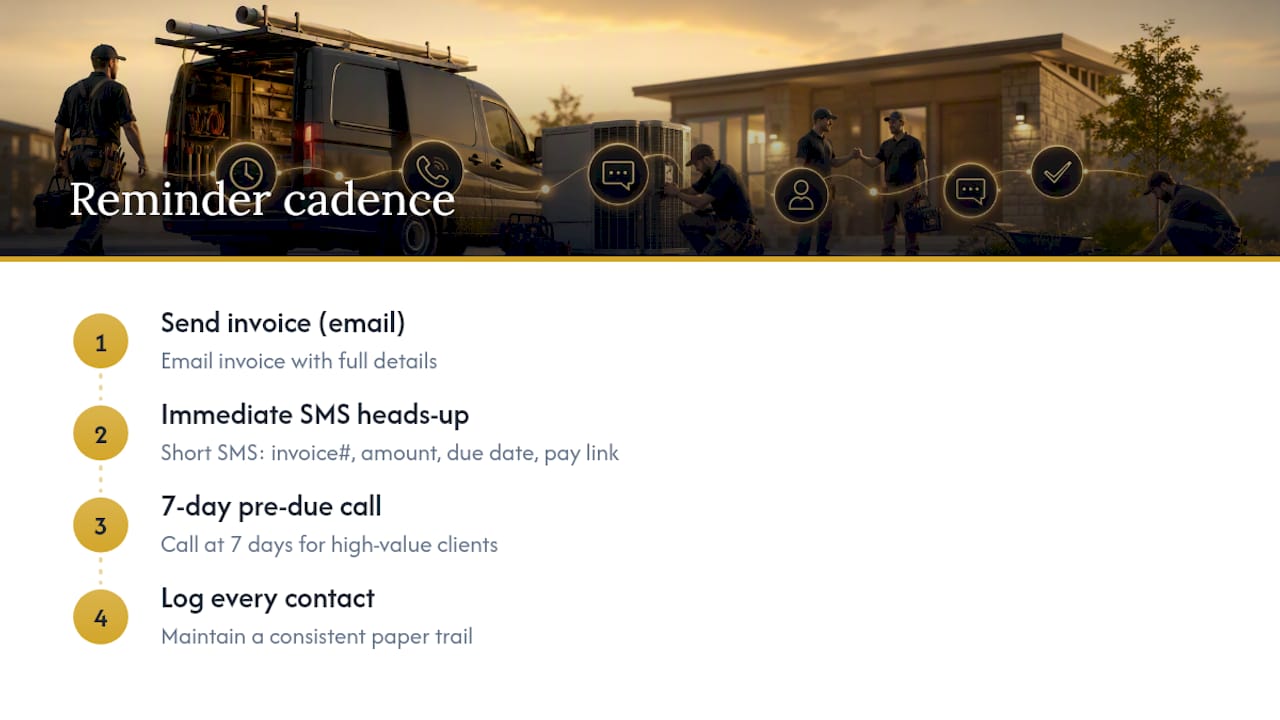
Email isn’t the only tool in your kit. Text messages get opened faster than email, often within minutes, which makes SMS a strong option for time-sensitive reminders, like a due-date nudge or a “your invoice was just sent” heads-up.
Keep text reminders short: the invoice number, amount, and due date, with a link to pay if your invoicing system supports it. Save the longer explanations for email, since a text isn’t the place for a paragraph about late fees or contract terms.
Some trades owners also use a quick phone call for the pre-due reminder on high-value jobs, especially with clients who don’t check email often. Others fold reminders into a client portal or payment link that shows the balance any time the client logs in.
The channel matters less than consistency. Pick one or two methods you’ll actually stick with, whether that’s email plus SMS, or email plus a phone call at the seven-day mark, and use them the same way every time. Mixing channels randomly (a text one week, a letter the next) makes your process look disorganized, which weakens your position if you ever need to show a consistent paper trail.
Handling common reasons for late payment and resolving disputes
Most late payments aren’t personal. A client forgot, their bookkeeper is behind, or the invoice landed in a spam folder. Starting from that assumption keeps your first few messages friendly, which tends to get faster results than jumping straight to threats.
Sometimes the delay is a genuine dispute: the client thinks the work wasn’t finished, disagrees with a change-order charge, or claims they never received a quote for extra materials. When that comes up, deal with it directly and in writing. Ask exactly what the concern is, compare it against your signed quote or work order, and respond with specifics rather than repeating the amount owed.

If the dispute is legitimate, a partial payment for the undisputed portion plus a quick resolution on the rest often unsticks the whole invoice. If the client is simply stalling, a documented dispute conversation still strengthens your position later, since a small claims judge wants to see that you tried to resolve things reasonably before escalating.
Cash-flow problems on the client’s side are trickier. A short payment plan, agreed in writing with specific dates, can be worth more than a lump sum you never see. Just make sure the plan is documented the same way you’d document a call: date, amount, and agreed timeline, confirmed by email.
Forge: a practical way to keep follow-ups from slipping through the cracks
Chasing late invoices gets harder when your customer info, quotes, and billing details live in three different places, your phone, a spreadsheet, and a stack of paper on the truck dash. Some software options keep customers, quotes, work orders, invoices, and follow-ups in one place, so you can see at a glance which invoices are overdue and which ones just need a reminder.
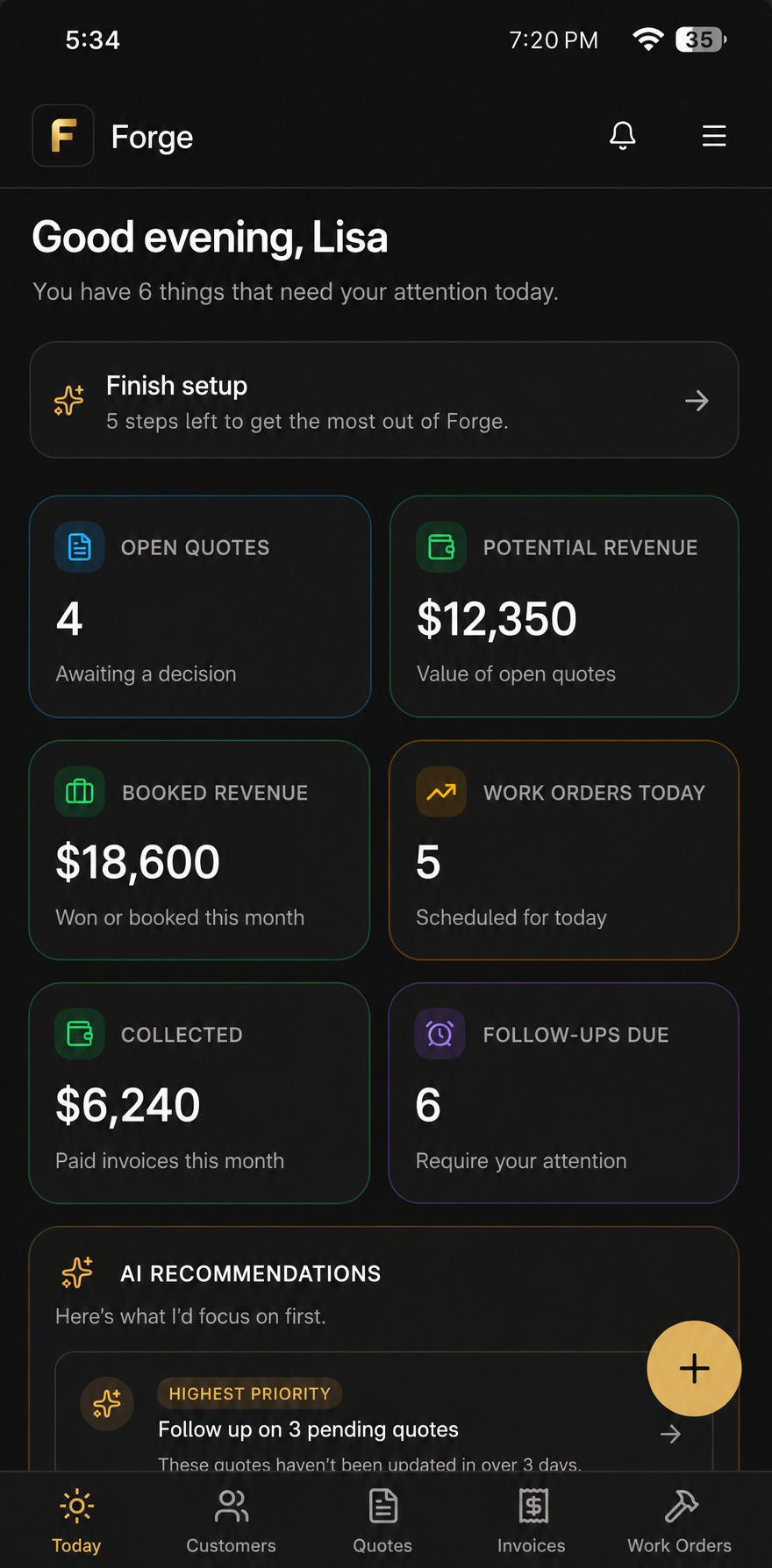
That kind of visibility means fewer invoices fall through the cracks simply because you got buried on a job site for two weeks. When everything sits in one system, sending the next reminder is a matter of checking a list, not remembering who you emailed last Tuesday. This kind of software won’t replace your accounting software, but it can give you a clear view of who owes what and what needs to happen next, which is half the battle with late invoice follow up.
If chasing payments is eating more of your week than the actual work, take a look at what Forge can do for your invoicing and follow-ups and see whether it fits how your business runs.
Sources
- How to collect bills more effectively
- Interest Act (Canada)
- How to Follow Up on an Unpaid Invoice | InvoiceFast
- Navigating Debt Recovery: Legal Strategies for Small Business Owners to Collect Unpaid Invoices | HS Legal PC
FAQ
How do I follow up on a late invoice?
Start with a short, polite email that reattaches the invoice, states the amount and due date, and asks for payment by a specific date. If there’s no response within about a week, follow up with a phone call and confirm anything agreed to in a same-day email.
How do I politely remind someone about an overdue invoice?
Assume good faith in your first message. Something like “just a friendly reminder that invoice #1042 is now a few days overdue, could you let me know when I can expect payment” gets better results than an accusatory tone, and most late payments turn out to be administrative, not intentional.
What should I say when an invoice is overdue?
State the invoice number, the exact amount owed, the original due date, and a clear next step, such as a specific payment date you’re asking them to meet. Avoid vague phrasing like “whenever you get a chance.”
When should I call instead of emailing about a late invoice?
Switch to a phone call once an invoice is about seven days overdue with no response to your emails. A call is harder to ignore and usually surfaces the real reason for the delay faster than another written notice.
How do I legally charge interest on a late invoice?
Under the Interest Act, any interest or late fee must be expressed as an annual rate, such as “24% per annum,” to be enforceable, and the terms need to be agreed to in your quote or contract before work begins.